
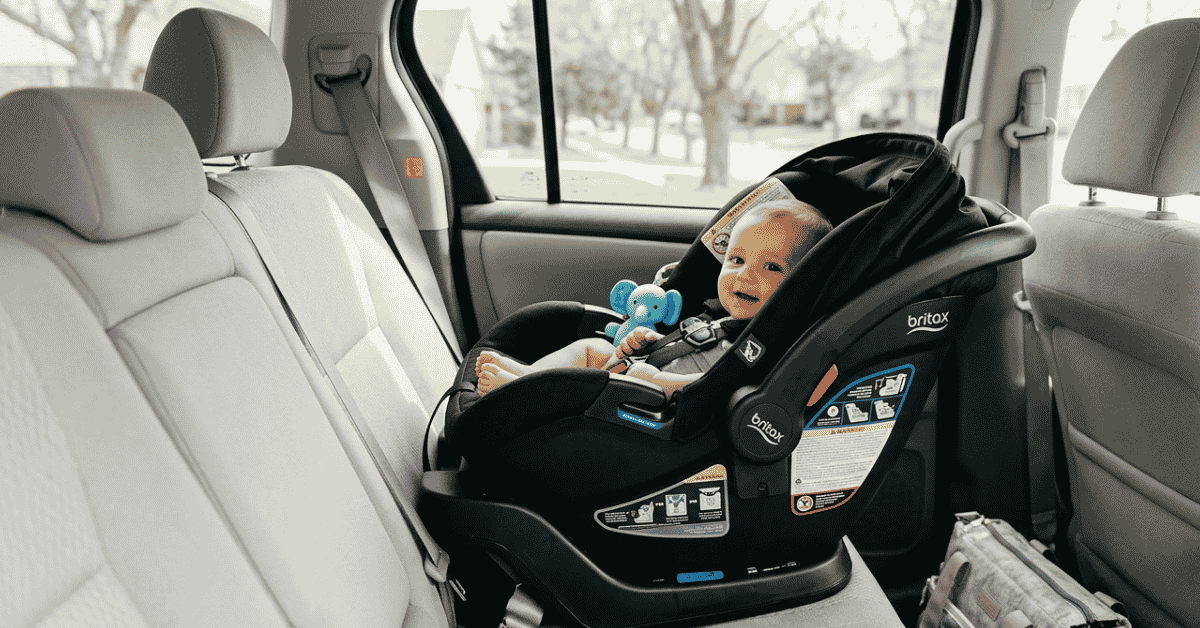
Every current Britax infant seat stops at 35 pounds or 32 inches, whichever hits first. Most babies hit the height line long before the weight one.
That’s the short version. The full Britax infant car seat weight limit lineup, B-Safe 35, B-Safe 35 Elite, B-Safe Gen2, Willow S, and Willow Grow, caps rear-facing use at 35 lbs and 32 inches. The floor starts at 4 lbs, with Britax recommending the infant insert until your baby clears 11 lbs. Height, not weight, is what actually ends the ride for most kids, usually somewhere between 12 and 18 months.
Key takeaways
- Weight ceiling: 35 lbs across every current Britax infant seat model.
- Height ceiling: 32 inches, or once your baby’s head sits within 1 inch of the shell’s top edge.
- Minimum weight: 4 lbs on most models; use the infant insert until 11 lbs.
- Real age-out point: most babies age out by height around 12–18 months, well under 35 lbs.
- Exceeding either number puts your kid outside the range the shell and harness were crash-tested for.
- The next seat is a convertible rear-facing to 40–50 lbs, not a forward-facing switch.
Britax infant car seat weight limit, by model
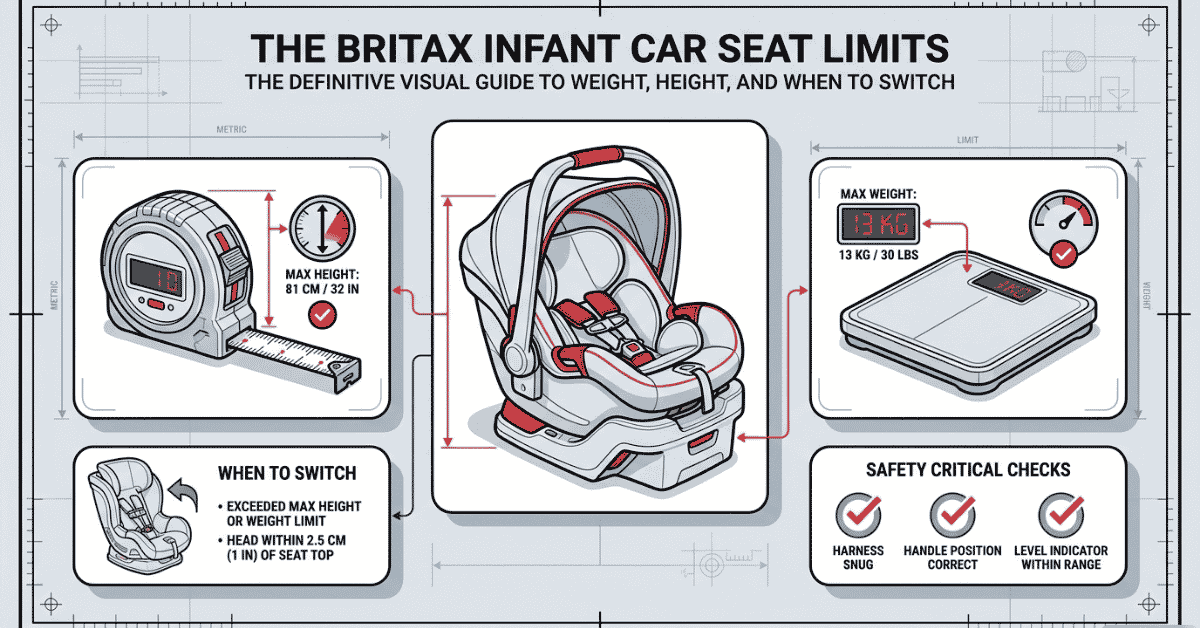
Britax sells four infant seats right now, and the weight numbers are nearly identical across the line. The differences show up in shell height and base features, not the top weight limit.
| Model | Weight limit | Height limit | Minimum weight |
|---|---|---|---|
| B-Safe 35 | 35 lbs | 32 in | 4 lbs |
| B-Safe 35 Elite | 35 lbs | 32 in | 4 lbs |
| B-Safe Gen2 | 35 lbs | 32 in | 4 lbs |
| Willow S | 35 lbs | 32 in | 4 lbs |
| Willow Grow | 35 lbs | Taller shell than B-Safe; confirm on your seat’s label | 4 lbs |
Britax revises specs across production runs, so the number on your actual seat’s label is the one that matters, not the number on a box from two years ago. Check the sticker on the side of the shell before you assume anything.
[INTERNAL LINK: Britax B-Safe 35 vs. B-Safe Gen2 comparison]
Minimum weight limit for a Britax infant seat: when your newborn is too small
Most Britax infant seats start at 4 lbs. That covers the vast majority of newborns, including many born early. Britax recommends using the infant insert (the head and body support pad) until your baby weighs 11 lbs, because a smaller newborn can slouch or shift inside a shell built for a 30-lb toddler.
If your baby weighs under 4 or 5 lbs, this seat isn’t automatically safe just because the box says so. The American Academy of Pediatrics recommends that very small or medically fragile preemies be evaluated by a car seat technician or their NICU team before hospital discharge. Some preemies go home in a car bed instead of a standard seat, lying flat rather than semi-reclined, until they’re big enough or stable enough for the angle a car seat requires.
Talk to your pediatrician before your discharge date, not after. Hospitals often run a pre-discharge “car seat challenge,” watching your baby’s oxygen levels and heart rate in the actual seat for a set period. That test catches problems a scale can’t.
Weight limit vs. height limit: which one ends rear-facing first
The 35-lb number gets all the attention, but height ends the ride for most families first. Britax requires at least 1 inch of shell above your baby’s head. Once their head passes that line, the seat is done, no matter what the scale says.
A baby in a higher height percentile might hit 32 inches by 9 or 10 months while still under 20 lbs. A baby who’s shorter but heavier could clear 35 lbs before they’re anywhere near 32 inches tall, though that’s rarer with typical growth curves. Either limit ends rear-facing use in the infant seat. There’s no partial credit for being under one number if you’ve cleared the other.
Measure height the way the manual describes it, standing your baby against a wall isn’t the same as measuring them lying flat in the seat’s actual recline angle. A tape measure and a helper beat guessing.
Signs your baby outgrew the seat before the weight limit says so
The numbers on the label are a ceiling, not a guarantee your baby fits comfortably right up until that point. Watch for:
- Ears reaching the top of the shell, even if there’s technically an inch of plastic left.
- Legs bent sharply against the seatback in front, a comfort issue more than a safety one, but a sign height is close.
- The harness’s top slot is maxed out and shoulders sit above it.
- Your baby can reach the harness buckle and pops it open mid-drive.
- The infant seat’s carrying handle strains or the base’s recline indicator no longer sits level with your baby’s weight distribution.
None of these alone means stop using the seat today. Together, they mean start shopping for the next one now, not after a road trip.
What happens if you exceed the Britax weight limit
Britax crash-tests the shell, harness webbing, and buckle hardware up to the stated limit, not beyond it. Past 35 lbs, the harness webbing can concentrate force across a smaller area of a bigger kid’s body in a hard stop, and the shell wasn’t engineered to distribute impact energy for that mass.
This isn’t a slow slide into risk. NHTSA and Britax both treat the printed limit as a hard stop, not a soft one. Continuing to use the seat past the label’s number also complicates things if you’re ever in a crash and need to file an insurance claim, since the seat was used outside its tested parameters.
If you’re a pound or two over with no convertible seat ready yet, that’s a real-world gap plenty of parents hit. The fix is to move up the timeline for the next seat, not to stretch the current one further.
Getting more mileage before you hit the limit
You can’t extend the hard weight or height ceiling, but you can make sure you’re using every inch and pound Britax built in.
- Pull the infant insert once your baby clears 11 lbs. Leaving it in longer doesn’t add protection and can push a bigger baby’s head too close to the shell’s edge.
- Move the harness to the correct height slot as your baby grows, not just when you remember to. The strap should sit at or slightly below shoulder height.
- Skip bulky winter coats under the harness. A puffy coat adds slack that shows up as loose straps in a crash, effectively lowering your real safety margin before you hit any printed number.
- Recheck the recline angle at the base every few months. A seat that’s drifted out of its correct recline range can make a baby’s height limit arrive sooner than it should.
None of this buys you extra pounds or inches. It just makes sure you’re using the full range Britax already built into the seat.
Britax weight limit vs. Graco and Chicco: how they compare
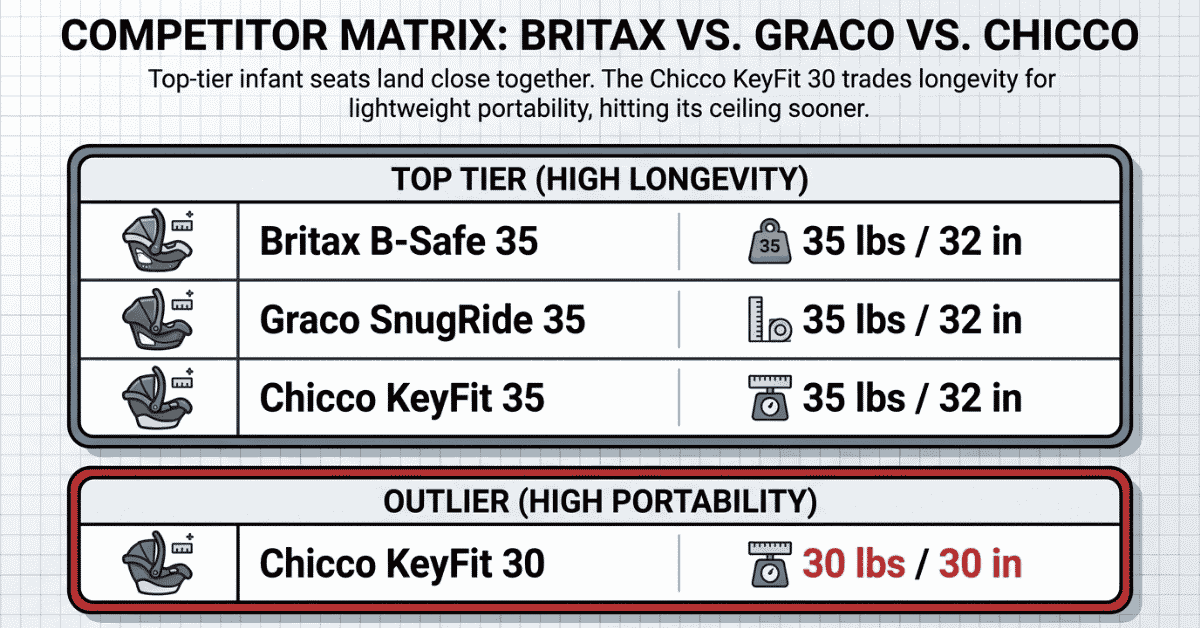
If you’re comparing brands before buying, the top-tier infant seats from Britax, Graco, and Chicco land close together on weight, with more spread on height and minimum weight.
| Model | Weight limit | Height limit | Minimum weight |
|---|---|---|---|
| Britax B-Safe 35 | 35 lbs | 32 in | 4 lbs |
| Graco SnugRide 35 | 35 lbs | 32 in | 4 lbs |
| Chicco KeyFit 35 | 35 lbs | 32 in | 4 lbs |
| Chicco KeyFit 30 | 30 lbs | 30 in | 4 lbs |
The KeyFit 30 is the outlier, a lower ceiling on both weight and height than the “35” models from all three brands. If you want the longest possible run before switching to a convertible, the 35-lb, 32-inch tier (Britax B-Safe/Willow, Graco SnugRide 35, Chicco KeyFit 35) buys the most time. The KeyFit 30 tends to be lighter and easier to carry one-handed, a real tradeoff for parents prioritizing portability over longevity.
[EXTERNAL LINK: NHTSA car seat safety ratings]
When to switch from a Britax infant seat to a convertible
The switch point is whichever limit arrives first, height or weight, not a fixed age. Most families make the move between 9 and 18 months.
A convertible seat isn’t a downgrade. Britax’s Boulevard ClickTight rear-faces to 40 lbs, and Graco’s Extend2Fit rear-faces to 50 lbs, both well past what any infant seat allows. The point of a convertible isn’t to flip your kid forward-facing right away, it’s to keep them rear-facing longer in a seat built for a bigger range.
Buy the convertible before you’re out of runway on the infant seat, not the week after. Installing and adjusting a new seat correctly takes time, and a rushed install the night before a trip is how mistakes happen. If your baby is close to either limit and you don’t have the next seat yet, that’s the priority purchase, ahead of anything else on a baby registry.
Choosing a Britax infant seat based on how long you need it to last
If you’re buying new and want the seat to last as long as possible, height matters more than the weight number on the box, since most babies age out by height first.
- Willow Grow has a taller shell than the B-Safe line, worth checking if you expect a taller baby or want extra months before switching.
- B-Safe 35 / B-Safe Gen2 are lighter to carry and often cheaper, a reasonable tradeoff if portability matters more than squeezing out extra months.
- Stroller compatibility matters here too. If you already own a Britax or compatible stroller frame, matching the seat saves buying a second travel system.
- A second base for a second car costs less than a second seat and is worth it if you split childcare across two vehicles.
There’s no single “best” pick here, it depends on whether you’re optimizing for longevity, weight, or price.
[INTERNAL LINK: Best convertible car seats after an infant seat]
Summary: how to know your Britax infant seat’s real limit
The printed numbers, 35 lbs and 32 inches, are the same across every current Britax infant seat. What changes the decision isn’t the number, it’s which limit your baby hits first, and whether the physical signs (ears at the shell’s edge, maxed harness slots, bent legs) show up before the label does.
Check the label on your actual seat, not a spec sheet from memory, since production runs change over time. Pull the infant insert at 11 lbs. Watch height more than weight, since it usually wins the race. And have the next seat, a convertible rear-facing to 40 or 50 lbs, ready before you need it, not after.
FAQ: Britax infant car seat weight limit questions
What is the weight limit for a Britax infant car seat?
Every current model, B-Safe 35, B-Safe 35 Elite, B-Safe Gen2, Willow S, and Willow Grow, has a 35-lb rear-facing weight limit paired with a 32-inch height limit.
Can a 4-month-old exceed the Britax weight limit?
It’s uncommon but possible for a baby with rapid weight gain. If your 4-month-old is closing in on 35 lbs, check height too, since that limit usually arrives first regardless of age.
What’s the minimum weight for a Britax infant seat?
Most models start at 4 lbs. Britax recommends keeping the infant insert in place until your baby reaches 11 lbs for proper head and body support.
Does Britax go by weight or height first?
Whichever limit your baby reaches first ends rear-facing use in the infant seat. In practice, height limits out most babies before weight does, usually between 12 and 18 months.
Can I still use the seat if my baby is over 35 lbs but under 32 inches?
No. Either limit alone ends use of that seat. You need a convertible car seat rated for your baby’s current weight and height once one ceiling is reached.
What car seat comes after a Britax infant seat?
A convertible seat is next, since it covers a wider rear-facing and forward-facing range. Britax’s Boulevard ClickTight rear-faces to 40 lbs; Graco’s Extend2Fit rear-faces to 50 lbs.