
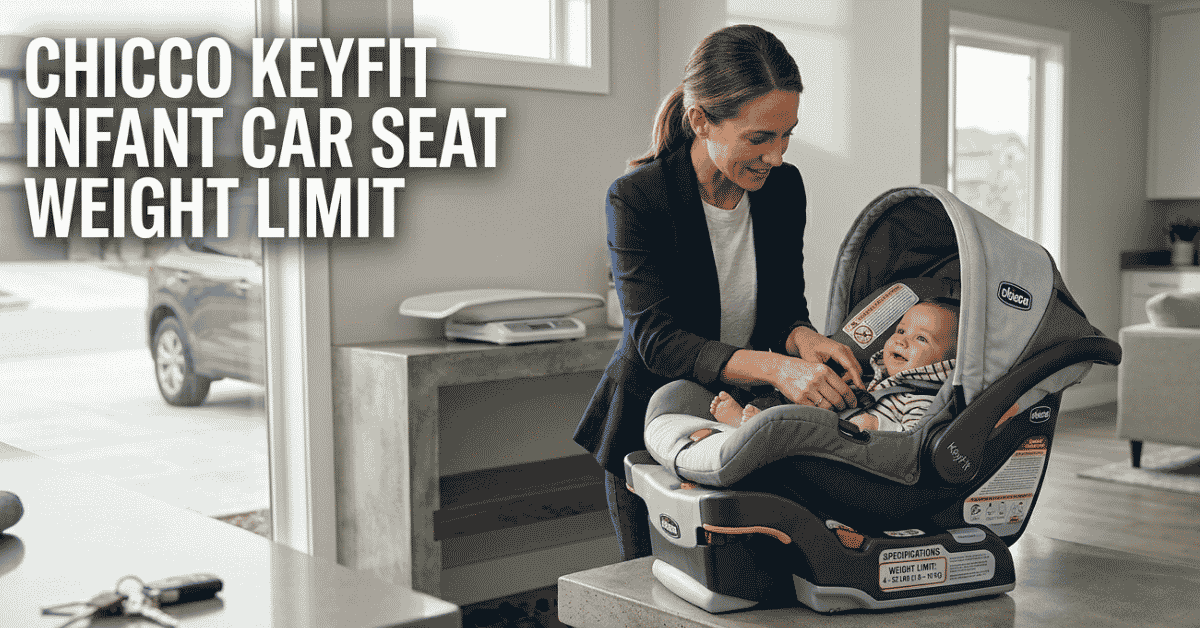
chicco keyfit infant car seat weight limit is one of the most important factors parents should understand before purchasing or continuing to use this popular infant seat. I remember helping a friend install a KeyFit before bringing home a newborn. Everything seemed straightforward until the conversation turned to weight and height limits. Many parents focus only on age, but car seat safety depends heavily on following manufacturer limits. This guide explains the Chicco KeyFit weight limits, height requirements, common misconceptions, and signs that your child is ready to move to the next stage.
The exact weight limit depends on the specific KeyFit model you own.
What Is the Chicco KeyFit Infant Car Seat Weight Limit?
Many parents assume all Chicco KeyFit seats have identical limits. That is not the case. Chicco offers several KeyFit models, and each has slightly different specifications. Understanding the correct limit helps ensure proper protection and compliance with manufacturer guidelines. Exceeding weight or height restrictions can reduce safety performance during a crash. The good news is that Chicco clearly labels these limits on the seat and in the owner’s manual. Checking your specific model is always the safest approach before making travel decisions.
KeyFit Weight Limits by Model
The most common models include:
| Model | Weight Limit | Height Limit |
|---|---|---|
| Chicco KeyFit | 4 to 22 lbs | Up to 30 inches |
| Chicco KeyFit 30 | 4 to 30 lbs | Up to 30 inches |
| Chicco KeyFit 35 | 4 to 35 lbs | Up to 32 inches |
| Chicco KeyFit Max | 4 to 30 lbs | Up to 32 inches |
These limits come directly from manufacturer specifications and product documentation.
Weight Is Not the Only Limit
Parents should also monitor:
- Height limits
- Head clearance requirements
- Proper harness fit
A child may outgrow the seat before reaching the maximum weight.
Rear-Facing Design
All KeyFit infant seats are:
- Rear-facing only
- Designed for newborns
- Intended for early infancy
Rear-facing remains the safest position for young children.
Why Limits Matter
Safety testing occurs within approved ranges.
Exceeding limits may affect:
- Crash performance
- Harness positioning
- Protective shell effectiveness
Manufacturer guidelines should always be followed.
How Long Do Babies Typically Fit in a Chicco KeyFit?
Many first-time parents assume the weight limit determines how long the seat will last. In reality, height often becomes the deciding factor. Children grow differently. Some reach the height limit long before approaching the maximum weight. Others remain within both limits for an extended period. Understanding these growth patterns helps parents prepare for the eventual transition to a convertible car seat without unnecessary surprises.
Height Usually Ends Usage First
Many child passenger safety experts observe that children often outgrow infant seats by height before weight.
Common reasons include:
- Long torso growth
- Faster height increases
- Limited shell space
This happens frequently with infant carriers.
The One-Inch Rule
Parents should monitor head clearance carefully.
Most rear-facing seats require:
- At least one inch of shell above the child’s head
This rule remains important even when weight limits have not been reached.
Typical Age Range
Many children use a KeyFit seat until:
- 9 months
- 12 months
- 15 months
Growth patterns vary significantly.
Growth Monitoring Tips
Check regularly:
- Weight
- Height
- Harness position
- Head clearance
Frequent checks help maintain safe usage.
Signs Your Child Has Outgrown a Chicco KeyFit Seat
Parents sometimes focus exclusively on weight numbers and miss other important indicators. Outgrowing a seat can happen in multiple ways. Understanding these signs helps ensure your child transitions at the appropriate time. The goal is not to use the seat for the longest possible period. The goal is using it safely within approved limits.
Maximum Weight Reached
This is the easiest sign to identify.
Once the child reaches:
- 22 pounds for KeyFit
- 30 pounds for KeyFit 30
- 35 pounds for KeyFit 35
the seat should no longer be used.
Maximum Height Reached
Height matters equally.
Limits include:
- 30 inches for many KeyFit models
- 32 inches for some newer models
Always verify your specific seat.
Insufficient Head Clearance
Even if weight and height remain within limits, a child may outgrow the seat if adequate shell space no longer exists above the head.
Harness Fit Problems
Watch for:
- Shoulder height concerns
- Tight fit issues
- Improper harness positioning
Proper harness adjustment remains essential.
Transitioning After the Chicco KeyFit Weight Limit
Eventually every infant seat gets outgrown. Planning ahead makes the transition much easier. Many parents move directly to a convertible car seat that supports extended rear-facing use. This next stage often provides higher weight and height limits while continuing to prioritize safety. Understanding your options before reaching the limit helps avoid rushed purchases and installation stress.
Consider a Convertible Car Seat
Convertible seats offer:
- Extended rear-facing capacity
- Higher weight limits
- Longer usability
Many families transition directly to this type.
Keep Children Rear-Facing
Safety experts generally recommend remaining rear-facing as long as possible within manufacturer limits. Rear-facing helps protect the head, neck, and spine during collisions.
Review Vehicle Compatibility
Before purchasing a replacement seat:
- Measure available space
- Check installation requirements
- Verify fit with your vehicle
Preparation simplifies the transition.
Register New Car Seats
Registration helps parents receive:
- Recall notifications
- Safety updates
- Manufacturer communications
This step takes only a few minutes.
Final Thoughts
The Chicco KeyFit infant car seat weight limit depends on the specific model. The original KeyFit supports children from 4 to 22 pounds, the KeyFit 30 supports 4 to 30 pounds, and the KeyFit 35 supports 4 to 35 pounds. Height limits and head clearance requirements also matter. Parents should regularly monitor growth and follow manufacturer guidelines carefully. Doing so helps ensure that children remain protected throughout every stage of infant travel.
FAQs
What is the weight limit for the Chicco KeyFit 30?
The Chicco KeyFit 30 is designed for children weighing 4 to 30 pounds and up to 30 inches tall.
What is the weight limit for the original Chicco KeyFit?
The original Chicco KeyFit generally accommodates children from 4 to 22 pounds and up to 30 inches tall.
Does height matter more than weight for infant car seats?
In many cases, children outgrow infant seats by height before reaching the maximum weight limit.
When should I switch from a KeyFit to a convertible car seat?
You should transition when your child reaches the weight limit, height limit, or no longer meets the required head clearance.
Is the Chicco KeyFit 35 different from the KeyFit 30?
Yes. The KeyFit 35 supports children up to 35 pounds and 32 inches, while the KeyFit 30 supports children up to 30 pounds and 30 inches.