
Introduction
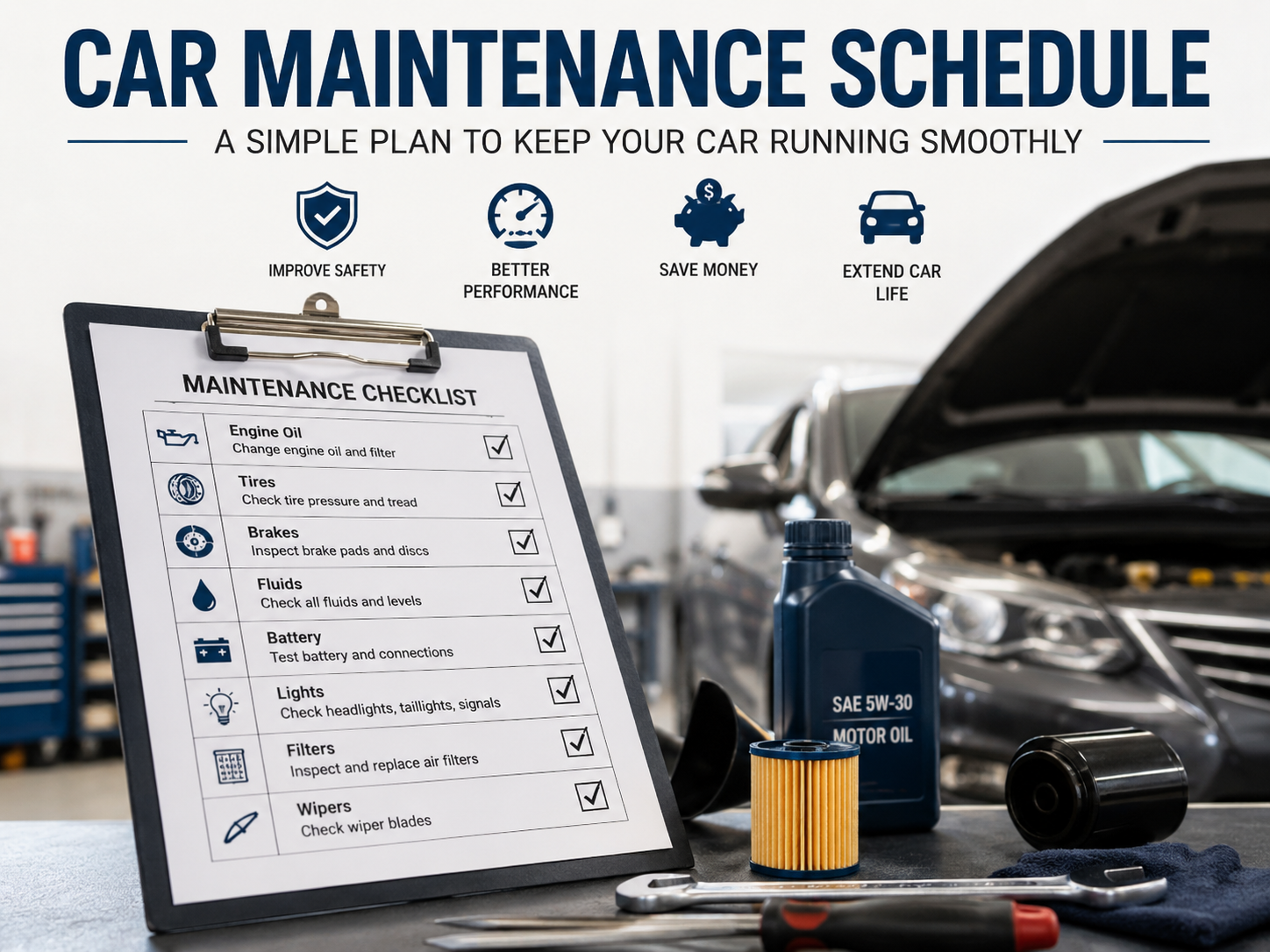
Car Maintenance Schedule helps you save money, avoid breakdowns, and keep your car safe with easy service tips for every season.
Car maintenance schedule habits can save you from a dead car on a busy Monday morning. I learned that the hard way after my old sedan stalled in heavy rain with smoke under the hood and horns all around me. Since then, I’ve stuck to a simple service plan that keeps my car smooth, safe, and far less costly to fix. In this guide, you’ll learn when to service your car, what checks matter most, and how to build a routine you can truly keep.
What Is a Car Maintenance Schedule?
Your car rarely breaks down all at once. Mine didn’t. It started with a faint burnt smell one humid Thursday evening while I sat in traffic with my AC blasting and coffee going cold in the cup holder. A week later, the battery gave up at the grocery store parking lot. That was the moment I stopped guessing and finally followed a real car maintenance schedule.
The Simple Meaning of Scheduled Maintenance
A car maintenance schedule is just a plan for checking and replacing parts before they fail. That’s it. Nothing fancy. It tells you what to service, when to do it, and what to keep an eye on as your mileage climbs.
I used to think car maintenance meant waiting until something broke. A weird sound? Turn the radio up. Small shake in the steering wheel? “It can wait till next month.” Bad idea. Very bad idea.
Now I see the difference clearly:
| Routine Maintenance | Emergency Repair |
|---|---|
| Oil change | Engine damage |
| Tire rotation | Flat tire on the highway |
| Brake inspection | Brake failure |
| Coolant refill | Overheated engine |
| Battery check | Car won’t start |
Automakers build maintenance timelines because cars wear down little by little. Oil gets dirty. Brake pads thin out. Tires lose grip. Even if the car feels fine, parts still age in silence.
One thing many drivers miss is this: mileage and time both matter.
For example:
- Low-mileage cars still need oil changes
- Brake fluid absorbs moisture over time
- Batteries weaken even when you rarely drive
- Rubber belts crack from heat and age
I learned that the hard way with my old sedan. I barely drove it during one rainy season, so I skipped service for months. The oil looked okay to me. The car disagreed.
What Is Scheduled Maintenance on a Car?
Scheduled maintenance on a car means following the service intervals suggested by the manufacturer. Most of these are listed right inside the owner’s manual, though I’ll admit mine sat unopened in the glove box for almost two years.
These intervals are based on:
- Mileage
- Driving habits
- Weather conditions
- Road quality
- Engine type
Most schedules include simple but important tasks like:
- Oil changes
- Tire rotation
- Brake inspections
- Fluid replacement
- Air filter changes
These jobs may seem small, but they keep the engine smooth and help avoid costly repairs later.
I remember talking to a driver during a brutally hot afternoon in Dhaka traffic. He laughed and said he never checks coolant because “the car still moves.” Two days later, steam poured from under his hood near a crowded intersection. The repair bill was painful. The wait in the heat was worse.
That story stuck with me because I almost did the same thing during a summer road trip. My coolant level was low, but I ignored it for weeks. Luckily, I checked it one Sunday morning before leaving town. That tiny five-minute check probably saved my engine.
Why Ignoring Maintenance Gets Expensive Fast
Small car problems grow quietly. That’s what makes them dangerous.
A skipped oil change can slowly damage the engine. Worn tires hurt fuel economy. Old brake fluid can affect stopping power during a sudden stop in heavy rain. At first, the car still runs, so it feels easy to delay things.
I’ve done it myself.
You hear a tiny noise and think:
“I’ll look at it next month.”
Then next month turns into three.
Soon:
- Fuel costs creep up
- The engine feels rough
- The car loses resale value
- Long drives become stressful
- Repair bills get ugly fast
One winter morning, my brakes started squealing so loudly that a guy crossing the street actually looked around for a bus. I laughed for about three seconds. Then the mechanic showed me how thin the brake pads were.
That visit taught me something simple: car maintenance schedules are not about being obsessed with cars. They’re about avoiding stress, saving money, and keeping your daily life running smoothly.
Why Every Driver Needs a Car Maintenance Schedule
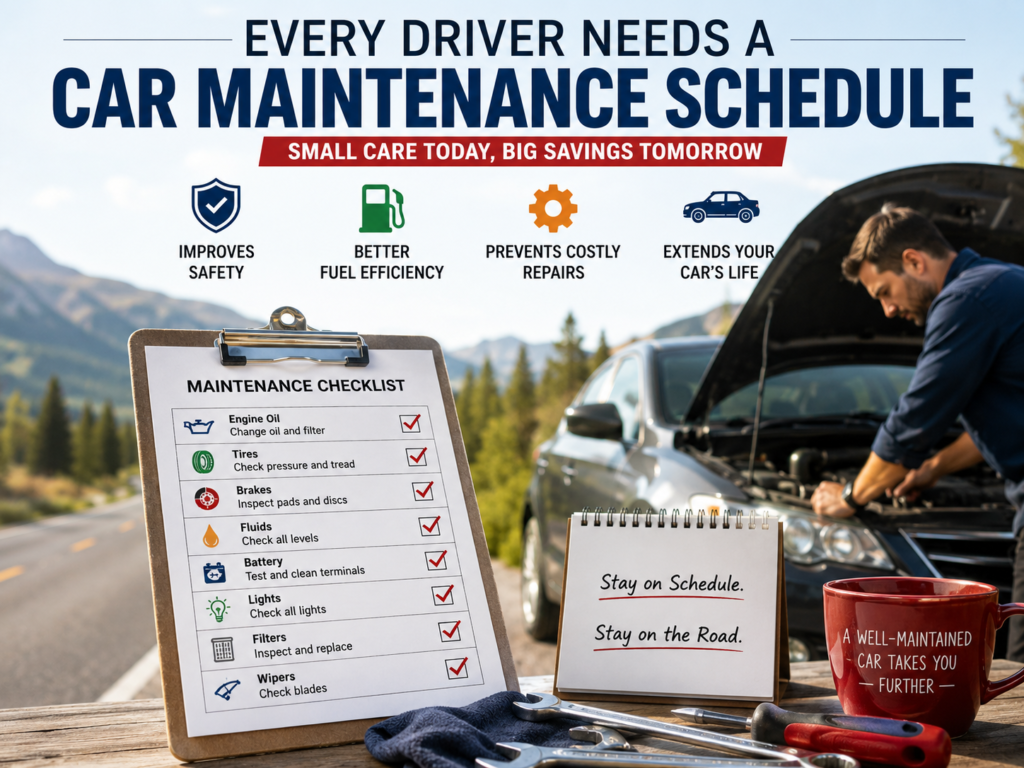
Most people think about car maintenance only after something goes wrong. I used to be the same. If the car started and moved, I assumed everything was fine. Then one rainy Friday night, my steering wheel started shaking on the highway while trucks rushed past me. That drive home felt much longer than it was.
Since then, I’ve learned that a car maintenance schedule does more than protect your car. It protects your wallet, your time, and honestly, your peace of mind too.
Saves Money Over Time
I once skipped a cheap transmission fluid service because I wanted to “save money.” A few months later, the transmission started jerking during traffic. The repair bill hurt so much I actually sat in silence for a full minute staring at the mechanic’s estimate.
That taught me something simple: preventive maintenance is almost always cheaper than emergency repairs.
Small jobs help stop big problems like:
- Engine damage
- Transmission failure
- Brake wear
- Uneven tire damage
Regular service also helps fuel efficiency. When my tires were underinflated for weeks, I noticed my fuel gauge dropping faster than usual. I kept blaming traffic. Turns out, it was partly my own fault.
Now I stay ahead of basic service tasks like:
- Oil changes
- Tire rotation
- Fluid checks
- Air filter replacement
They cost less now than major repairs later. Much less.
| Preventive Maintenance | Costly Repair It May Prevent |
|---|---|
| Oil change | Engine failure |
| Tire rotation | Early tire replacement |
| Coolant check | Overheated engine |
| Brake inspection | Brake system damage |
| Transmission fluid service | Transmission rebuild |
Makes Your Car Last Longer
Cars age like people. Ignore them long enough, and they start complaining in strange noises.
I noticed this with my older sedan around the ten-year mark. If I skipped maintenance, the engine felt rough and tired. But after proper service, it sounded smoother. The whole car just felt happier. Weirdly enough, so did I.
A good car maintenance schedule helps:
- Protect the engine
- Reduce wear and tear
- Keep the transmission healthy
- Prevent overheating
Older cars need even more consistency. Parts loosen. Rubber seals dry out. Tiny leaks appear where they never did before.
One cold morning, I heard a faint ticking sound after starting the car. I almost ignored it. Thankfully, my mechanic checked it early and caught a worn belt before it snapped. That small fix saved me from getting stranded halfway to work.
Improves Safety on the Road
This part matters most to me now.
A poorly maintained car can turn stressful fast, especially during rain or long drives at night. I found that out during a storm when my worn wiper blades smeared water across the windshield instead of clearing it. For ten very tense minutes, I could barely see lane markings.
Since then, I pay closer attention to:
- Brake performance
- Tire traction
- Battery health
- Wiper blade condition
Good tires grip the road better during heavy rain. Healthy brakes stop faster in traffic. A strong battery saves you from awkward moments in parking lots while strangers pretend not to notice you struggling to restart the car.
I still laugh thinking about the time I had to ask two teenagers outside a convenience store for a jump start. Humbling experience.
Helps During Resale or Trade-In
I didn’t care about maintenance records until I tried selling my old car.
The buyer asked:
“Do you have service history?”
I pulled random receipts from the glove box like I was entering a game show under pressure. Not my finest moment.
A clean maintenance history builds trust fast. Buyers and dealerships like seeing proof that the car was cared for properly.
Keeping records can help:
- Increase resale value
- Speed up trade-in inspections
- Show proof of regular maintenance
- Build buyer confidence
Now I keep all service papers in one small folder under my desk. Nothing fancy. Just organized enough so future me doesn’t panic again.
A car maintenance schedule may seem boring at first. Mine did too. But after dealing with overheating engines, weak batteries, rough brakes, and expensive repairs, I see it differently now.
It’s less about cars.
It’s more about avoiding those awful moments that ruin your whole day.
Basic Car Maintenance Schedule by Mileage
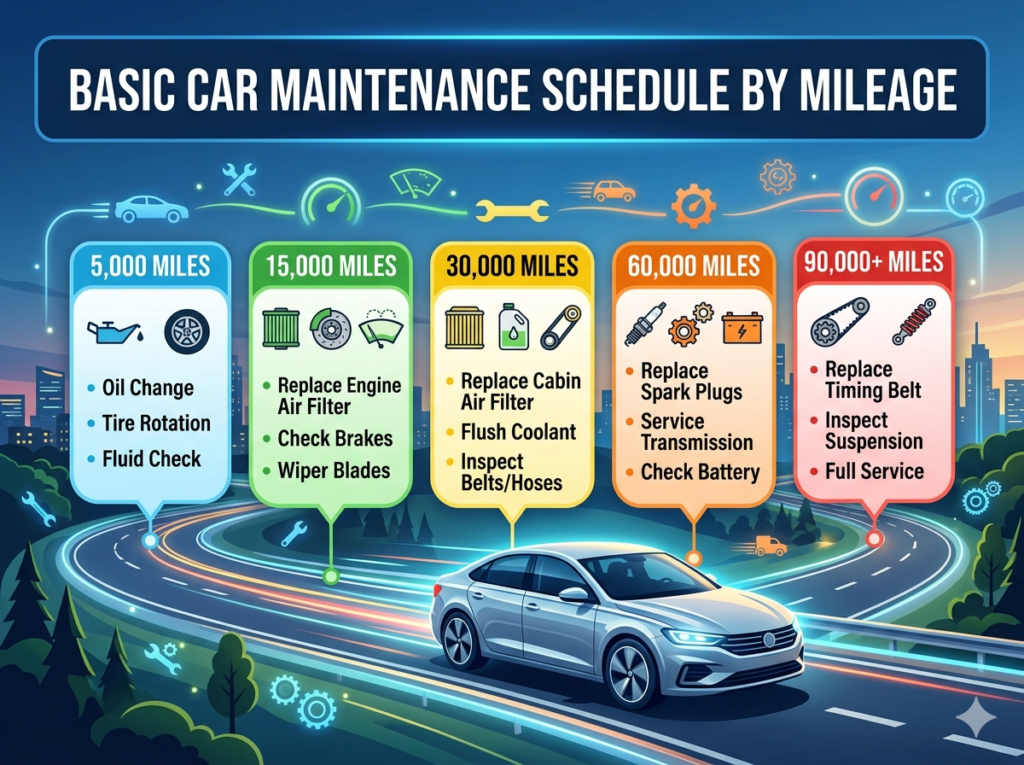
Every car maintenance schedule looks a little different, but most follow the same basic pattern. I didn’t realize that until I started tracking my own service visits on old fuel receipts stuffed inside my center console. Before that, I just guessed. My car suffered for it.
Once I started following mileage checkpoints, things changed. The engine felt smoother. The brakes felt sharper. Even my fuel costs dropped a bit. Funny how a few small habits can make a car feel years younger.
Every 3,000–5,000 Miles
This is the part of the car maintenance schedule I never skip now. These small services keep daily wear from turning into big trouble later.
At this stage, I usually handle:
- Oil and oil filter change
- Tire pressure check
- Fluid top-offs
- Quick brake inspection
Oil changes matter more than many drivers think. I once delayed one for almost two months during a busy work stretch. By the end, the engine sounded rough at stoplights, almost like it was quietly complaining.
Fresh oil helps:
- Reduce engine wear
- Improve fuel economy
- Keep the engine cool
- Remove dirt buildup
I also check tire pressure more often now, especially before highway trips. One cold morning, I found one tire way below normal pressure right before leaving town. That tiny check probably saved me from a flat tire on the road.
Every 10,000–15,000 Miles
This part of the maintenance schedule focuses more on stability and long-term performance.
I usually book:
- Tire rotation
- Air filter replacement
- Battery inspection
- Wiper blade replacement
The first time I changed my engine air filter, I was honestly shocked. It looked like a dusty old doormat after allergy season.
A dirty air filter can:
- Reduce airflow
- Hurt fuel efficiency
- Make the engine work harder
Battery checks matter too. Batteries rarely fail at a “good” time. Mine died on a humid Sunday evening outside a pharmacy parking lot while ice cream slowly melted in the back seat. Not ideal.
Wiper blades are another thing people forget. I ignored mine once during monsoon season. Huge mistake. Instead of clearing rain, they smeared water across the windshield like wet paint.
Every 30,000 Miles
Around this mileage, I started noticing how much hidden wear builds up inside a car.
This stage often includes:
- Brake fluid inspection
- Transmission fluid check
- Wheel alignment
- Suspension inspection
Transmission fluid service is one job many people delay because the car still “feels okay.” I used to think the same thing. Then my shifts started feeling jerky during slow traffic near downtown one hot afternoon.
Turns out, old transmission fluid loses effectiveness over time.
Wheel alignment also makes a huge difference. When my alignment was off, the steering wheel pulled slightly left every single drive. I thought I was imagining it for weeks.
A suspension inspection helps catch:
- Worn shocks
- Loose parts
- Uneven tire wear
- Rough ride quality
Little issues show up slowly. That’s what makes them easy to ignore.
Every 60,000–100,000 Miles
This is where major maintenance usually starts showing up on a car maintenance schedule.
These services may include:
- Timing belt replacement
- Spark plugs
- Coolant flush
- Full system inspection
I remember putting off spark plug replacement because the car still started fine. Then fuel economy dropped, acceleration felt sluggish, and the engine started idling rough at red lights.
After new spark plugs, the difference felt immediate.
Timing belts are another serious item. If one snaps while driving, engine damage can get expensive very fast. That repair bill can ruin a perfectly good month.
Coolant flushes matter too, especially in hot climates. During one brutal summer afternoon, I watched steam rise from a stalled SUV near traffic lights while drivers leaned on their horns behind it. Ever since then, I take coolant service seriously.
Maintenance Based on Time, Not Mileage
This surprised me the most when I first learned about it.
Cars that sit unused still need maintenance.
I used to think low mileage meant I could delay service forever. Then I learned:
- Oil breaks down with age
- Brake fluid absorbs moisture
- Batteries weaken while sitting
- Rubber seals dry out over time
One of my neighbors barely drove his car more than 5,000 miles a year. Mostly short grocery trips and weekend coffee runs. Still, his battery failed early because the car sat parked for long stretches.
That changed how I look at car care.
Now I follow both:
- Mileage intervals
- Time-based maintenance schedules
Here’s the simple version I keep in mind:
| Mileage Range | Common Maintenance Tasks |
|---|---|
| 3,000–5,000 miles | Oil change, tire pressure check, brake inspection |
| 10,000–15,000 miles | Tire rotation, air filter, battery check |
| 30,000 miles | Brake fluid, alignment, transmission fluid |
| 60,000–100,000 miles | Timing belt, spark plugs, coolant flush |
A basic car maintenance schedule may seem boring on paper. In real life, though, it saves you from roadside stress, expensive surprises, and those awful moments when your car suddenly decides it has had enough.
How to Create a Car Maintenance Schedule
Creating a car maintenance schedule sounds harder than it really is. I used to imagine giant spreadsheets, color codes, and people who somehow enjoy organizing receipts on Sunday mornings. Turns out, my system now fits on my phone and one slightly greasy notebook in the glove box.
Honestly, once I started tracking things properly, owning a car felt less stressful. No more guessing. No more standing beside the mechanic pretending I totally remembered my last oil change.
Start With the Owner’s Manual
I ignored my owner’s manual for years. It stayed buried under old insurance papers and fast-food napkins until one Saturday afternoon when my check engine light came on during a grocery run.
That little book ended up answering half my questions.
Your owner’s manual shows:
- Factory service intervals
- Recommended oil type
- Tire pressure levels
- Fluid replacement timing
- Brake inspection schedules
It also explains something many drivers miss:
“Normal” driving and “severe” driving are not the same thing.
I used to think severe driving meant racing through deserts like an action movie hero. Apparently not.
Severe driving can include:
- Stop-and-go city traffic
- Short daily trips
- Hot weather
- Dusty roads
- Heavy rain
- Carrying extra weight
That changed how I viewed my own driving habits. Sitting in long traffic jams with the AC running during humid afternoons absolutely counts as harder use for a car.
Here’s a simple way I look at it now:
| Driving Type | Maintenance Impact |
|---|---|
| Highway driving | Less engine strain |
| City traffic | More brake and engine wear |
| Short trips | Faster oil breakdown |
| Hot climates | More coolant stress |
| Rainy roads | Faster wiper wear |
Track Mileage and Service Dates
This was the habit that finally made my car maintenance schedule stick.
Before, I relied on memory. Terrible system. I once forgot an oil change for nearly 2,000 extra miles because I was “pretty sure” I had already done it.
Now I track:
- Mileage
- Service dates
- Repair costs
- Upcoming maintenance
I use simple tools like:
- Phone reminders
- Maintenance apps
- Google Calendar
- Printable maintenance logs
Nothing fancy.
Every time I leave the repair shop, I sit in the parking lot for one minute and set the next reminder right away. If I don’t do it immediately, future me magically forgets.
I also keep receipts and service records now. That habit saved me once when a shop accidentally recommended a service I had already completed months earlier.
Build a Monthly Maintenance Habit
Monthly checks sound annoying at first, but they usually take less time than waiting in line for coffee.
On the first Sunday of each month, I do a quick walk around my car while it warms up.
I check:
- Tire pressure
- Headlights and brake lights
- Windshield wipers
- Fluid levels
- Strange smells or sounds
- Leaks under the car
One morning, I noticed a tiny dark spot under the engine while backing out of my driveway. Small leak. Easy fix. If I had ignored it longer, it could have become expensive fast.
Cars usually whisper before they scream.
Now I pay attention to:
- Clicking sounds
- Burning smells
- Rough idling
- Vibrations
- Slow starts
Sometimes the car is basically begging for help in the politest way possible.
Seasonal Maintenance Tips
Weather changes can affect your car more than most people realize. I learned that after one freezing winter morning when my battery barely started and the dashboard lit up like a Christmas tree.
Now I adjust my car maintenance schedule with the seasons.
Summer Maintenance
Hot weather can be rough on engines.
I always check:
- Coolant levels
- AC performance
- Tire pressure
- Engine temperature
One July afternoon, I opened my car door and got hit with air so hot it felt like opening an oven. Since then, I never ignore coolant checks before long summer drives.
Winter Maintenance
Cold weather exposes weak batteries fast.
Before winter, I inspect:
- Battery condition
- Tire tread
- Heater performance
- Windshield washer fluid
I also keep a small flashlight and jumper cables in the trunk now. Learned that lesson the cold way.
Rainy Season Maintenance
Rain creates its own problems.
I pay extra attention to:
- Wiper blades
- Brake response
- Tire grip
- Defogging systems
During one stormy evening drive, my old wipers smeared water so badly I had to lean forward and squint through a tiny clear patch on the windshield like an old pirate searching for land.
Never again.
A good car maintenance schedule does not need to be perfect. Mine definitely isn’t. I still forget things sometimes. But having a simple system makes car ownership feel far less chaotic.
And honestly, that small peace of mind feels pretty great when you turn the key on a cold Monday morning and the engine starts without drama.
How to Schedule Car Maintenance Without Forgetting
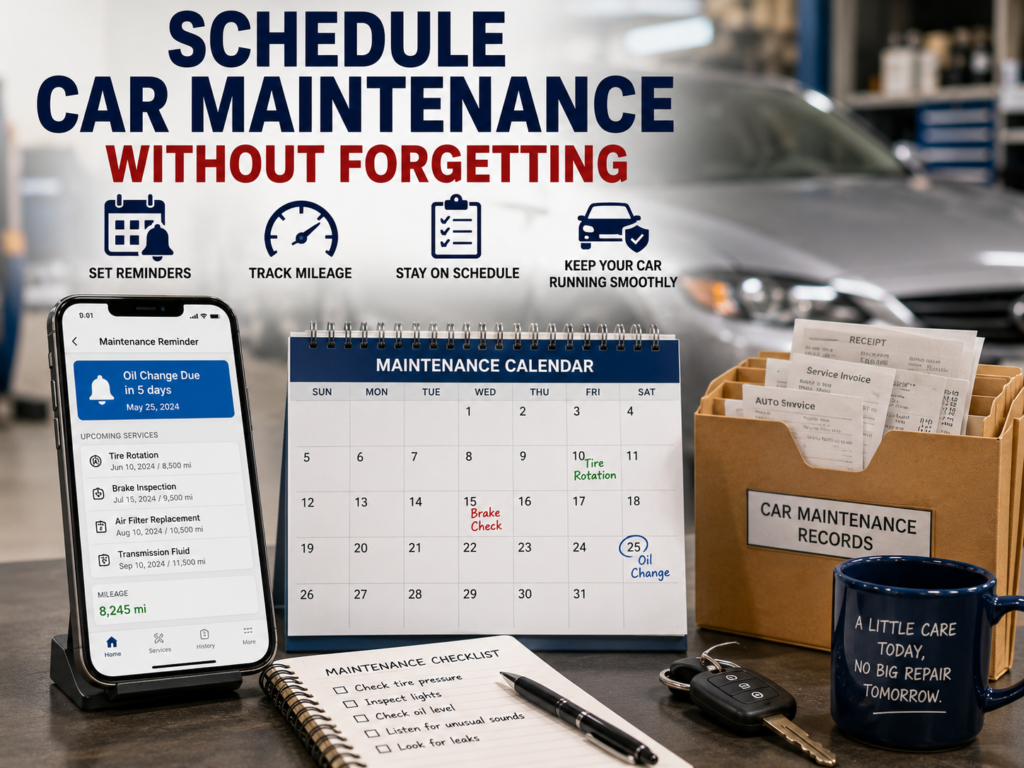
Life gets busy fast. I can remember movie quotes from ten years ago but somehow once forgot an oil change for nearly half a year. That is the strange thing about car maintenance schedules. Most of us know they matter, but daily life keeps pushing them into the background.
What finally helped me was building small habits instead of relying on memory alone. Because honestly, memory is unreliable when you are tired, late for work, or distracted by twenty other things.
Use Digital Reminders
This changed everything for me.
Before using reminders, my car maintenance schedule lived entirely inside my head. Terrible place for important information. One missed service turned into another, and suddenly I was sitting inside a repair shop on a humid Tuesday afternoon paying far more than I should have.
Now I use:
- Car maintenance apps
- Smartphone alerts
- Dealer reminder systems
- Google Calendar notifications
The moment I finish a service visit, I create the next reminder before leaving the parking lot.
That tiny habit saves me constantly.
Most maintenance apps can track:
- Oil changes
- Tire rotation
- Brake inspections
- Mileage
- Repair history
Some even send alerts based on mileage instead of dates, which helps if your driving habits change often.
I still laugh remembering the time my phone reminded me about a tire rotation while I was literally eating fries inside my parked car outside the repair shop. Future me appreciated that reminder.
Follow Mileage-Based Scheduling
One thing I misunderstood for years was how quickly mileage adds up.
I thought:
“I barely drive.”
Then I checked my odometer one Sunday morning and realized city traffic had quietly added thousands of miles faster than I expected.
Now I estimate:
- Weekly driving distance
- Monthly mileage
- Road trip mileage
- Seasonal driving habits
That helps me schedule maintenance before problems show up.
For example:
- Long highway trips wear tires differently
- Heavy traffic increases brake wear
- Summer heat strains coolant systems
Before any road trip now, I check:
- Oil condition
- Tire pressure
- Coolant level
- Brake feel
I learned that lesson after driving four hours with slightly underinflated tires during a summer weekend trip. The steering felt odd the entire drive, and I spent half the trip convincing myself everything was “probably fine.”
Usually, “probably fine” is not a great maintenance strategy.
Here’s the simple tracking method I use now:
| Driving Habit | Maintenance Impact |
|---|---|
| Daily city traffic | Faster brake wear |
| Long highway drives | More tire wear |
| Short trips | Faster oil breakdown |
| Hot weather driving | More coolant stress |
| Heavy weekend driving | Quicker mileage buildup |
Schedule Around Your Routine
I used to delay service appointments because they felt inconvenient. Then I realized breakdowns are far more inconvenient.
Now I schedule maintenance around my normal week instead of waiting for the “perfect” time that never arrives.
What works best for me:
- Early morning appointments
- Weekend garage visits
- Service before road trips
- Booking slower weekdays when possible
Morning appointments save me the most time. Repair shops usually get busier later in the day, especially before holidays or long weekends.
One Saturday, I ignored my own advice and showed up at a busy shop around noon. The waiting room smelled like burnt coffee and old tires, kids were crying near the TV, and I sat there long enough to memorize the snack machine prices.
Never again.
Now I try to book early whenever possible.
Keep a Maintenance Folder
This sounds boring. I know. I thought so too.
Then one day a mechanic asked when my transmission fluid was last changed, and I gave him the same confused look people give during surprise math quizzes.
That was the day I started keeping records.
Now I store:
- Service receipts
- Warranty papers
- Inspection reports
- Tire purchase records
- Repair estimates
I keep digital copies on my phone and paper copies in a small folder at home.
This helps more than people realize.
Good records can:
- Prevent duplicate services
- Help during resale
- Track repair patterns
- Support warranty claims
One small folder now saves me from a lot of guessing and awkward conversations.
A car maintenance schedule only works if you can actually follow it. Mine became easier once I stopped trying to be perfect and focused on being consistent instead.
That small shift made car ownership feel far less stressful.
And honestly, hearing your engine start smoothly on a freezing Monday morning feels weirdly satisfying after all that effort.
How Long Does Scheduled Car Maintenance Take?
This was one of the first things I searched when I seriously started following a car maintenance schedule. I wanted exact times. Clean answers. Something simple like:
“Oil change = 20 minutes.”
Real life turned out slightly messier than that.
Some visits really are quick. Others somehow turn into a full-day event where you drink bad waiting-room coffee and start reading old magazines you would never touch anywhere else.
Quick Maintenance Visits
These are the easy ones.
Most quick services include:
- Oil changes
- Tire rotations
- Battery testing
- Fluid top-offs
- Basic inspections
On a normal weekday morning, my oil changes usually take around:
- 20 to 45 minutes
Tire rotations are often similar:
- 30 to 45 minutes
Battery testing can be surprisingly fast:
- 10 to 20 minutes
Of course, “quick” depends heavily on timing.
I once stopped by a repair shop on a quiet Tuesday morning and finished an oil change before my coffee even cooled down. Another time, I visited on a Saturday afternoon before a holiday weekend. Huge mistake. I waited so long I started memorizing the music playlist overhead.
That day taught me something:
Fast service depends on when you go, not just what you need.
Here’s the rough timeline I now expect:
| Service Type | Typical Time |
|---|---|
| Oil change | 20–45 minutes |
| Tire rotation | 30–45 minutes |
| Battery testing | 10–20 minutes |
| Brake inspection | 30–60 minutes |
Medium-Length Services
This is where things start taking longer than most people expect.
Medium-length maintenance jobs often include:
- Brake replacement
- Fluid flushes
- Wheel alignment
- Cooling system service
Brake service usually takes:
- 1 to 3 hours
Fluid flushes vary depending on the vehicle and condition:
- Around 1 to 2 hours
Wheel alignments often take:
- About 1 hour
I remember getting a brake replacement one rainy afternoon after weeks of hearing a faint grinding sound during traffic. I thought it would take maybe an hour.
Three hours later, I was still sitting there scrolling through weather updates and debating whether vending machine crackers counted as lunch.
Turns out, worn brake parts made the repair more complicated than expected.
That is the tricky part about scheduled car maintenance. Small hidden problems sometimes appear once mechanics start inspecting the vehicle closely.
Major Scheduled Maintenance
These are the big appointments.
This stage of a car maintenance schedule usually includes:
- Timing belt replacement
- Transmission service
- Spark plug replacement
- Major inspections
- Suspension work
Major repairs can take:
- Half a day
- A full day
- Sometimes longer
Timing belt replacement alone may take:
- 4 to 8 hours
Transmission servicing depends on the car and condition:
- Around 2 to 5 hours
Multi-point inspections also add time because mechanics check:
- Brakes
- Suspension
- Fluids
- Belts
- Hoses
- Tires
- Battery health
I learned this the hard way after scheduling what I thought was a “simple” major service before a weekend trip. I planned to wait at the shop for a couple of hours.
Bad plan.
The mechanic found worn belts and a leaking hose during inspection, so my “quick stop” quietly became an all-day appointment. By late afternoon, I knew every smell inside that waiting room.
Still better than breaking down on the highway later.
Factors That Affect Service Time
This surprised me most when I first started following a proper car maintenance schedule.
The actual repair is only part of the timing.
Several things can slow service down:
- Parts availability
- Dealership workload
- Older vehicle complications
- Weather
- Holiday rushes
Older cars especially take longer sometimes. Rusted bolts, worn parts, and previous repairs can all complicate things.
My older sedan once needed extra time simply because one rusted bolt refused to come loose. The mechanic joked that the bolt had “emotionally attached itself to the engine.”
Honestly, fair enough.
Weather also affects repair shops more than people realize. Before long holiday weekends or during cold winter mornings, garages get packed fast with dead batteries, tire problems, and overheating issues.
That is why I now try to:
- Schedule early mornings
- Avoid holiday rushes
- Book appointments before road trips
- Leave extra time for unexpected issues
Here’s the simple truth I learned:
A car maintenance schedule works best when you stop treating service appointments like tiny errands squeezed between everything else.
Cars are machines. Machines take time.
And honestly, waiting a few extra hours at a repair shop feels much better than sitting stranded on the side of the road with steam pouring from under the hood while strangers stare as they drive past.
Honda Car Maintenance Schedule Explained
Honda cars have a reputation for lasting a long time, and honestly, that reputation is a big reason I trusted mine during long drives and messy traffic jams. But I learned something important over the years:
Reliable does not mean maintenance-free.
I once skipped a scheduled service on my old Honda Civic because the car still “felt fine.” Two months later, the brakes started making a grinding sound during stop-and-go traffic on a humid evening drive home. That lesson stayed with me.
A proper Honda car maintenance schedule makes a huge difference, especially if you drive daily in city traffic, heat, rain, or rough roads.
Honda Maintenance Minder System
The first time I saw the Honda Maintenance Minder warning pop up on my dashboard, I honestly thought something was seriously wrong.
Turns out, it was just my car politely asking for maintenance before problems started.
Honda’s Maintenance Minder system tracks:
- Oil life percentage
- Driving conditions
- Engine load
- Mileage
- Service intervals
Instead of giving one fixed timeline, the system adjusts based on how you actually drive.
Common Honda dashboard alerts include:
- Oil change reminders
- Tire rotation alerts
- Brake inspection notices
- Transmission fluid service codes
At first, I ignored the oil life percentage because the engine still sounded smooth. Bad move.
By the time the oil life dropped really low, the engine felt rougher during idle, especially while sitting in traffic with the AC running.
Now I pay attention much earlier.
Here’s the simple breakdown I follow:
| Honda Maintenance Code | What It Usually Means |
|---|---|
| A | Oil change |
| B | Oil and inspection service |
| 1 | Tire rotation |
| 2 | Air filter and cabin filter |
| 3 | Transmission fluid replacement |
| 4 | Spark plug inspection |
Those small alerts save a lot of guesswork once you understand them.
Typical Honda Service Intervals
Most Honda car maintenance schedules follow similar service patterns, though exact timing depends on the model and driving style.
My usual routine includes:
- Oil changes every few thousand miles
- Tire rotation during regular service
- Brake inspections during seasonal checks
- Transmission fluid service at recommended intervals
City driving changes everything.
Heavy traffic, short trips, and constant braking wear parts faster than long highway drives. I noticed this clearly after moving from mostly highway commuting to crowded downtown traffic. My brake wear increased much faster than before.
Typical Honda maintenance tasks include:
- Oil and filter changes
- Brake inspections
- Tire balancing and rotation
- Transmission fluid checks
- Coolant inspections
- Air filter replacement
One summer afternoon, I delayed transmission fluid service because the car still shifted “mostly fine.” Then traffic started crawling during rush hour, and the transmission suddenly felt jerky and rough.
That service appointment became urgent very quickly.
Popular Honda Models and Maintenance Needs
Different Honda models have slightly different maintenance habits. I noticed this after talking with friends and mechanics who owned multiple Honda vehicles.
The Honda Civic usually handles daily commuting really well, but city driving can wear brakes and tires faster.
The Honda Accord often feels smoother on long highway drives, though regular transmission service still matters a lot over time.
The Honda CR-V handles family trips and rough weather nicely, but heavier vehicles sometimes put more stress on tires and suspension parts.
I noticed highway driving tends to be easier on the engine overall:
- Fewer stops
- Less braking
- More stable temperatures
City driving is rougher because of:
- Constant stopping
- Heat buildup
- Slow traffic
- Short trips
One rainy evening in traffic, my Civic spent nearly forty minutes creeping forward block by block while the cooling fans worked nonstop. That kind of driving absolutely affects long-term wear.
Honda Dealer vs Independent Mechanic
I used to think dealerships were always too expensive. Then I learned it depends on the repair.
For routine maintenance, I sometimes use independent mechanics because:
- Labor costs are lower
- Appointments are faster
- Smaller shops often feel more personal
But for certain Honda-specific repairs, dealerships can help because they:
- Know Honda systems better
- Use factory diagnostic tools
- Handle warranty repairs
- Offer OEM parts
OEM parts are original parts made for Honda vehicles. Aftermarket parts are third-party replacements.
I have used both.
Some aftermarket parts work perfectly fine. Others do not last nearly as long. I learned that after buying cheap brake pads once. They squealed so loudly during slow stops that pedestrians actually turned around to look at my car.
Never again.
Here’s the simple comparison I keep in mind:
| Service Option | Best For |
|---|---|
| Honda dealership | Warranty work, complex diagnostics |
| Independent mechanic | Basic maintenance, lower costs |
| OEM parts | Long-term reliability |
| Aftermarket parts | Lower upfront price |
A Honda car maintenance schedule is not complicated once you settle into a rhythm. The hardest part is staying consistent.
And honestly, hearing a Honda engine start smoothly after years of ownership feels strangely satisfying. Especially when you remember all the little maintenance jobs that quietly kept it alive.
Common Car Maintenance Mistakes Drivers Make
Even careful drivers fall into bad car habits sometimes. I definitely have. Most mistakes do not start with laziness either. They start with tiny thoughts like:
“That noise is probably nothing.”
“I’ll schedule the service next week.”
“The warning light can wait a few more days.”
Then suddenly you are standing beside your car in a parking lot on a humid afternoon wondering why the engine smells strange.
A car maintenance schedule helps a lot, but only if you actually follow it consistently. That was the hard part for me.
Ignoring Warning Lights
I used to think dashboard warning lights were overly dramatic.
One evening, my check engine light turned on during slow traffic after work. The car still drove normally, so I ignored it for almost two weeks. Brilliant decision.
Turns out, a small sensor issue had slowly started affecting engine performance.
That experience taught me something important:
Dashboard lights exist for a reason.
Drivers commonly ignore:
- Check engine light
- Oil pressure warning
- Battery warning light
- Brake system alert
- Tire pressure warning
The worst myth I believed was:
“If the car still moves, it must be fine.”
Not always.
Sometimes warning lights appear before major damage happens. Catching problems early usually means:
- Lower repair costs
- Faster repairs
- Less engine damage
- Better fuel economy
Now when a warning light appears, I at least scan the issue quickly instead of pretending my dashboard is just feeling emotional.
Delaying Oil Changes Too Long
This is probably the mistake I regret most.
I once pushed an oil change far past the recommended interval during a busy month. At first, nothing felt different. Then the engine slowly became louder during cold starts. Fuel economy dropped too.
By the time I finally changed the oil, the old oil looked thick, dark, and honestly a little horrifying.
Old oil causes:
- Sludge buildup
- Increased engine wear
- Poor lubrication
- Rough engine performance
- More heat buildup
Fresh oil keeps engine parts moving smoothly. Dirty oil does the opposite.
I noticed the difference immediately after finally getting the service done. The engine sounded calmer at stoplights, especially during hot weather traffic.
Now I never delay oil service just because the car “still feels okay.”
That logic cost me enough already.
Forgetting Tire Maintenance
Tires are easy to ignore because they rarely complain loudly at first.
Mine certainly did not.
I skipped tire rotations for far too long once, mostly because I kept forgetting. Then one rainy evening, I noticed the car felt oddly slippery during turns near a wet intersection.
Later, the mechanic showed me uneven tire wear that could have been prevented easily.
Now I pay much closer attention to:
- Tire pressure
- Tire rotation
- Tire tread depth
- Wheel alignment
Poor tire maintenance can cause:
- Reduced fuel economy
- Uneven tire wear
- Weak wet-road traction
- Longer stopping distance
- Rougher handling
One cold morning, I checked my tire pressure before a highway drive and found one tire dangerously low. That tiny five-minute check may have saved me from a roadside headache later.
Honestly, tires quietly affect almost everything:
- Safety
- Comfort
- Fuel use
- Braking
- Steering feel
And yet most of us ignore them until something feels very wrong.
Skipping Fluid Checks
This mistake sneaks up slowly.
Fluids do not usually create dramatic warning signs right away. Problems build quietly in the background.
I learned that after ignoring coolant checks during a brutally hot summer stretch. One afternoon, I noticed the temperature gauge climbing higher than normal while sitting in traffic with the AC running full blast.
That moment got my attention fast.
Now I check fluids regularly:
- Coolant
- Brake fluid
- Transmission fluid
- Power steering fluid
- Windshield washer fluid
Each one matters more than many drivers realize.
Coolant helps prevent overheating.
Brake fluid affects stopping performance.
Transmission fluid keeps gear shifts smooth.
Power steering fluid helps steering stay responsive.
I once drove with low power steering fluid without realizing it. The steering suddenly felt heavy while parking, almost like wrestling a shopping cart with one bad wheel.
Not fun.
Here’s the simple maintenance table I keep in mind now:
| Maintenance Mistake | Possible Problem |
|---|---|
| Ignoring warning lights | Engine or electrical damage |
| Delaying oil changes | Sludge and engine wear |
| Forgetting tire care | Poor traction and uneven wear |
| Skipping fluid checks | Overheating or transmission issues |
A car maintenance schedule works best when small problems stay small.
That is really the whole goal.
Because from my experience, cars rarely break down all at once. They usually whisper first. The trouble starts when we keep pretending not to hear them.
Tools and Apps That Help Manage Car Maintenance
Technology made my car maintenance schedule much easier to follow. Years ago, I relied on memory alone. Terrible system. I once forgot a tire rotation for so long that the front tires wore unevenly before I even noticed.
Now my phone reminds me before problems show up.
Honestly, that small change reduced a lot of stress.
Because most car maintenance mistakes do not happen from laziness. Life simply gets busy. Work piles up. Rain starts pouring. Weekends disappear faster than expected.
Good tools help you stay ahead before small issues become expensive ones.
Best Car Maintenance Apps
I used to keep maintenance notes on random fuel receipts stuffed into the glove box. Then one humid afternoon, a mechanic asked when I last changed my transmission fluid.
I stared at him like he had asked me advanced physics.
That was the moment I finally started using car maintenance apps.
Now I use apps mainly for:
- Mileage tracking
- Service reminders
- Expense logging
- Repair history
- Oil change schedules
The biggest advantage is consistency.
Most apps remind you about:
- Oil changes
- Tire rotations
- Brake inspections
- Battery service
- Registration dates
Mileage tracking helped me most.
I once believed:
“I barely drive.”
Then I checked my monthly mileage after weeks of city traffic and grocery runs. Turns out, short trips add up fast.
Expense tracking also surprised me. Seeing repair costs over time helped me notice patterns, especially when one aging battery started causing repeated problems during cold mornings.
Here’s the simple setup I follow now:
| Tool Type | What It Helps Track |
|---|---|
| Maintenance apps | Service reminders |
| Mileage trackers | Driving distance |
| Expense logs | Repair costs |
| Calendar alerts | Future maintenance dates |
One funny moment still sticks with me. My phone reminded me about an oil change while I was literally sitting inside the car eating fries in a parking lot. Perfect timing honestly.
Useful Physical Tools for Drivers
Some car tools look unnecessary until the exact moment you desperately need them.
I learned that one rainy evening after my battery died outside a convenience store while thunder rolled overhead and my groceries slowly warmed in the trunk.
Since then, I keep a few basic tools in the car at all times.
The ones I actually use most are:
- Tire pressure gauge
- Portable jump starter
- OBD2 scanner
- Flashlight
- Gloves
A tire pressure gauge became part of my monthly routine after I discovered one tire dangerously low before a highway trip.
That tiny tool probably saved me from a roadside headache.
Portable jump starters are another lifesaver. I bought one after standing awkwardly in a parking lot asking strangers for jumper cables during a freezing morning.
Never again.
An OBD2 scanner also helps more than I expected. It reads basic engine trouble codes when the check engine light appears. It does not replace a mechanic, but it helps me understand whether the issue might be small or serious.
And honestly, a flashlight sounds boring until you drop something near the engine at night or need to inspect a leak under the car during rain.
Here’s the small emergency kit I now keep in my trunk:
| Tool | Why I Keep It |
|---|---|
| Tire pressure gauge | Prevent uneven wear |
| Portable jump starter | Dead battery emergencies |
| OBD2 scanner | Read warning codes |
| Flashlight | Night inspections |
| Gloves | Cleaner roadside checks |
My trunk basically became a tiny rolling survival kit after owning older cars for long enough.
When to Visit a Professional Mechanic
This lesson took me longer to learn than it should have.
I used to ignore problems until they became impossible to avoid. Small noise? Turn the radio louder. Faint smell? Open the windows and pretend everything felt normal.
Not smart.
Now I visit a mechanic quickly if I notice:
- Strange engine noises
- Burning smells
- Fluid leaks
- Vibrations while driving
- Rough shifting
- Brake grinding
- Steering problems
One summer afternoon, I smelled something burning while sitting in traffic with the AC blasting. I almost ignored it because the car still drove normally.
A leaking fluid line turned out to be the cause.
Catching it early saved me from a much larger repair later.
Vibrations are another warning sign I no longer ignore. My steering wheel once shook badly during highway speeds, especially on a rainy Friday evening drive home. I kept convincing myself the road was rough.
Turns out, my tires needed balancing and alignment.
Cars usually give warnings before major breakdowns happen.
The hard part is listening before the problem gets expensive.
That is why my car maintenance schedule matters more to me now than it did years ago. Not because I love spending weekends at repair shops.
Honestly, I would rather be almost anywhere else.
But after dealing with overheating engines, weak batteries, worn tires, and rough brakes, I finally learned something simple:
Small maintenance habits create much bigger peace of mind later.
FAQs
What is a car maintenance schedule?
A car maintenance schedule is a simple plan for oil changes, tire checks, and fluid service based on time or mileage. Learn more about routine car care tips.
How often should I follow a car maintenance schedule?
Most drivers follow a car maintenance schedule every 3,000–10,000 miles, depending on driving habits, weather, and vehicle type. Learn more about mileage intervals.
Can I skip oil changes if I barely drive my car?
No. Even low-mileage cars need oil changes because oil breaks down with time and moisture buildup. Learn more about time-based car maintenance schedules.
Why does my car maintenance schedule matter for safety?
A car maintenance schedule helps keep brakes, tires, and batteries working properly, especially during rain or long trips. Learn more about safe driving habits.
What happens if I ignore my car maintenance schedule?
Ignoring a car maintenance schedule can lead to engine wear, poor fuel economy, overheating, and expensive repairs later. Learn more about common maintenance mistakes.